
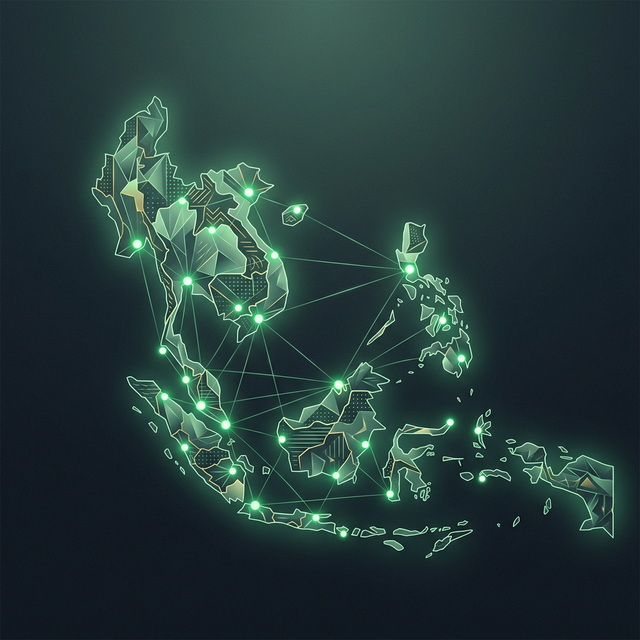
ASEAN is home to 700 million people across ten countries. Over 400 million are internet users. The region's mobile penetration rate stands at 136%. Its digital economy is on track to exceed $300 billion in GMV by 2025, growing at 15% annually. By virtually every metric, Southeast Asia is one of the most dynamic digital markets on Earth.
It is also one of the most complex.
The Diversity Challenge
Building technology products for ASEAN is fundamentally different from building for a homogeneous market. The region presents every dimension of diversity simultaneously:
Linguistic. ASEAN spans nine official languages — English, Vietnamese, Thai, Malay, Indonesian, Lao, Burmese, Cambodian, and Filipino. But that's just the surface. Indonesia alone recognizes over 700 languages. The Philippines has approximately 180. Many languages are tonal, others use distinct scripts, and direct translation between them often fails to capture cultural nuance.
Economic. Singapore's GDP per capita exceeds $65,000. Myanmar's is under $1,200. Designing for both markets requires products that work across vastly different purchasing power levels, payment infrastructure maturity, and digital adoption curves.
Cultural. Business practices, communication norms, and social expectations vary dramatically across the region. What resonates in Thailand may fall flat in Vietnam. What works in urban Jakarta differs from what works in rural Java.
Regulatory. Each country has its own data protection laws, licensing requirements, and compliance frameworks — with significant evolution happening in real time. Indonesia's Data Protection Law, Singapore's PDPA amendments, Vietnam's forthcoming PDPL, and Thailand's active enforcement each create distinct operating requirements.
Infrastructure. Internet speeds, smartphone capabilities, and connectivity reliability differ substantially across and within countries. A product designed for Singapore's broadband infrastructure will fail in rural Cambodia.
Why Most Products Get It Wrong
The typical approach to ASEAN markets follows one of two flawed strategies:
Strategy 1: Build for one market, then expand. Companies build for Singapore or Indonesia, then try to adapt for other markets. This approach consistently underestimates the depth of localization required. Translation isn't localization. Changing the language on a button doesn't address differences in payment preferences, communication patterns, or cultural expectations.
Strategy 2: Build globally, then localize. Companies build a product designed for Western markets, then "localize" for ASEAN. This approach treats diversity as a last-mile problem rather than a design principle. The result is usually a product that feels foreign everywhere.
Both strategies optimize for the wrong thing: efficiency of development rather than quality of experience.
Designing for Diversity: Our Principles
At amBit, ASEAN's diversity isn't a challenge we manage — it's the design constraint that shapes everything we build. Here are the principles that guide our approach:
1. Conversation as Universal Interface
In a region of extraordinary linguistic diversity, the most universal interface is the one people already use every day: conversation. Rather than building complex visual interfaces that need to be redesigned for each market, our conversation-first architecture lets users interact with AI in their own language, through natural chat.
amBit is built as a Web3-native communication platform — with messaging, wallet, and AI integrated from the ground up. In a region where Telegram commands 78% of crypto social engagement and crypto group participation surged 340% in 2024, meeting users in the communication paradigm they already live in is essential.
2. Mobile-First, Not Mobile-Adapted
With smartphone penetration at 80% across the region and rising, mobile isn't an afterthought — it's the primary computing paradigm. Our architecture is designed for mobile-first interaction: efficient on bandwidth, optimized for smaller screens, and functional on a range of device capabilities.
3. Economically Flexible
A pricing model that works in Singapore won't work in Myanmar. Our platform is designed to support flexible access across different economic realities. Core features — messaging, wallet, and Ami Basic AI — are permanently free for all users. Premium tiers offer advanced capabilities for power users, while the free tier ensures that economic barriers never exclude anyone from the platform.
4. Culturally Aware
Ami Pro's persistent memory doesn't just remember what you said — it learns how you communicate. Users in different markets have different communication styles, formality expectations, and interaction preferences. An AI assistant serving a crypto fund in Singapore should behave differently from one serving a community manager in rural Thailand — not because one is better, but because the cultural context demands it.
5. Compliance by Architecture
Rather than bolting on compliance as a country-by-country exception handler, we build regulatory awareness into our architecture. Data localization requirements, consent management, and breach notification protocols are handled at the infrastructure layer — so our platform operates within the legal frameworks of each market without compromising user experience.
The $2 Trillion Opportunity
The ASEAN digital economy is projected to reach $2 trillion by 2030, particularly with the implementation of the ASEAN Digital Economy Framework Agreement (DEFA). This represents one of the largest growth opportunities in global technology.
But capturing this opportunity requires building products that genuinely serve the region's diversity — not products that treat 700 million people as a monolithic market. The platforms that understand this distinction will be the ones that define the next decade of technology in Southeast Asia.
Our Commitment
amBit is built in ASEAN, for ASEAN, by a team that understands the region's complexity firsthand. With operations across Singapore and Hong Kong, we have direct access to the markets we serve.
We're not building a product and hoping it works in Southeast Asia. We're building a product because of Southeast Asia — because this is where the confluence of mobile connectivity, linguistic diversity, digital economy growth, and Web3 adoption creates an opportunity that exists nowhere else.
amBit is the AI messenger for Web3 communities — where communication, market intelligence, and AI assistance come together. Learn more at ambitsmp.com.