
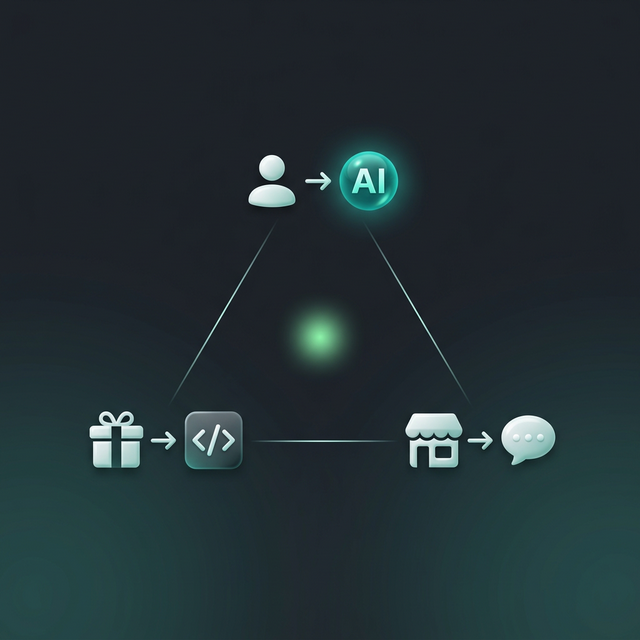
If you have spent any time studying Asian business strategy, you have encountered the framework of 人货场 — People, Goods, and Venue. It is the lens through which nearly every major Asian commerce platform has been conceived, from Alibaba to Pinduoduo to Shopee. Who is the customer? What is the product? Where does the transaction take place? Simple questions, but the companies that answer them best tend to dominate their markets.
In the age of AI Agents, all three elements of this framework are being restructured. Not incrementally improved — fundamentally redefined. Understanding how is critical for anyone building or investing in the next generation of commerce platforms.
People: From Consumers to Agent Proxies
In traditional e-commerce, the "People" component refers to human consumers who browse, compare, deliberate, and eventually purchase. The entire UX stack — from product listings to search filters to recommendation algorithms — is designed to guide a human through this decision process.
In the Agent economy, your AI Agent increasingly handles this process on your behalf. Your Agent knows your size, your brand preferences, your budget range, your purchase history, and your aesthetic sensibility — not because it surveilled you, but because it remembers you. Through persistent memory, it accumulates an increasingly accurate model of your decision-making patterns over time.
This has profound implications for commerce platforms. The "customer" is no longer a human browsing a product page. It is an Agent conducting a structured evaluation across dozens of options simultaneously, factoring in real-time pricing, reviews, delivery timelines, and personal preference weightings — all in milliseconds. Platforms that are optimized for human attention (infinite scroll, banner ads, impulse-buy triggers) will become progressively less relevant. Platforms optimized for Agent-to-Agent interaction will win.
Goods: From Fixed Products to Dynamic Capabilities
The traditional "Goods" in the commerce trinity refers to physical or digital products — manufactured, inventoried, listed, and sold. But in the Agent era, the definition of "goods" expands dramatically.
Through Vibe Coding, any user can generate a complete functional application through natural conversation in under 30 seconds. Through the Skills Store, any Agent can acquire professional-grade capabilities — financial analysis, legal document review, e-commerce customer service — with a single command. These are not products in the traditional sense. They are dynamic capabilities — generated on demand, infinitely customizable, and instantly distributable.
A developer creates a sophisticated futures trading analysis Skill, publishes it to the Skills Store, and within hours, thousands of Agents across the network have learned it. The "product" was created once but generates continuous value through adoption. This is a fundamentally different economic model than manufacturing-and-distribution. It is closer to what the software industry looks like when the barriers to creation approach zero.
Venue: From Storefronts to Conversations
Perhaps the most radical shift is in the "Venue" — the place where transactions happen. For centuries, that venue was a physical marketplace. Then it became a website. Then an app. Each successive shift made transactions more accessible but also more fragmented: you needed different apps for shopping, banking, booking, payments, and communication.
In the Agent era, the venue collapses into a single, universal interface: the conversation. You do not navigate to a shopping app. You tell your Agent what you need. You do not open a trading platform. You describe your strategy. The conversation itself — happening through amBit's unified IM layer, powered by the OpenClaw protocol — becomes the storefront, the workspace, the trading floor, and the social space, all at once.
The Three Flows That Close the Loop
What makes this restructuring powerful is the convergence of three flows within a single platform:
Information Flow. All messages, from all IM platforms, unified into a single stream via the OpenClaw protocol. Your Agent sees everything. No context-switching. No information scattered across five different apps.
Money Flow. Transactions happen natively within the ecosystem: marketplace purchases, Skills Store acquisitions, livestream tipping, enterprise SaaS payments, Agent-to-Agent services. The entire financial lifecycle — from earning to spending to reinvesting — stays within the platform.
Capability Flow. Through the Agent Social Protocol, capabilities themselves become a tradeable commodity. One Agent learns a Skill, and the entire network can inherit it. Developers create capabilities once and earn revenue every time another Agent adopts them.
When all three flows — information, money, and capability — close their loop within a single platform, something fundamental shifts. The platform stops being a tool and becomes an economy. A self-sustaining system where value is created, exchanged, and compounded without ever leaving the ecosystem. That is the transition we are building toward.